Ad Ops, Yield Manager & Publisher Monetization Interview Questions and Answers
The interview will ask what happens in the 200 milliseconds before an ad appears.
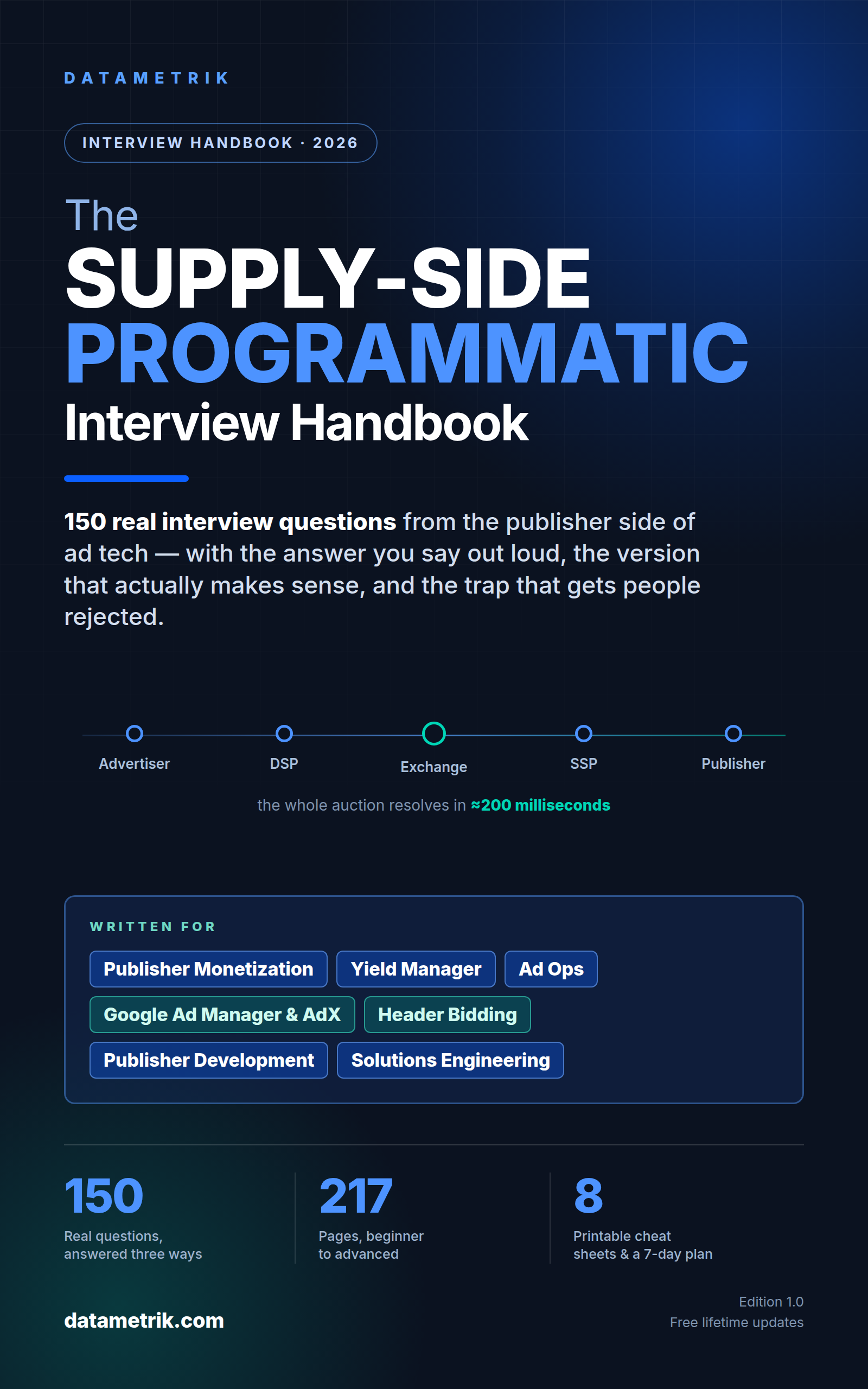
150 real interview questions from the publisher side of ad tech — each one answered three ways: the answer you say out loud, the version that actually makes sense, and the trap that gets people rejected.
Free lifetime updates at the same link
Interview questions for Ad Ops, Yield Management and Publisher Monetization roles
You know the acronyms. That is exactly the problem.
Most people walk into an SSP or publisher-side interview able to define SSP, DSP, RTB and eCPM — and still lose the offer. Not because they knew too little. Because the knowledge came out in the wrong shape.
What gets people rejected
- Describing the ad request path with no clock in it — no timeout, no milliseconds, no "whoever responded in time"
- Saying "third-party cookies are being deprecated in Chrome" — eighteen months out of date, and instantly noticed
- Confusing MCM Manage Inventory with Manage Account — the single most common factual error in publisher interviews
- Optimising eCPM in isolation when asked about floors — the classic yield own-goal interviewers plant deliberately
- Answering a troubleshooting question by guessing a cause instead of narrowing the scope
- Having no questions at the end — scored, and remembered
What this book fixes
- A script for every answer. Written to be said out loud in 30–60 seconds, structured the way senior people structure things.
- The plain-English version underneath it, so when they push and ask "but why?", you are not standing on a memorised sentence with nothing beneath it.
- The trap, named. On the questions that end candidacies, you get the wrong answer written out and why it costs the offer.
- Current as of 2026. Privacy Sandbox retired. Cookie reversal. Antitrust status. Curation. Agentic buying. Principal-based buying.
- A diagnostic order for every troubleshooting question, because interviewers mark the order, not the answer.
- Printable cheat sheets for the hour before.
Three layers. Every single question.
Here is a real, unedited page from the book — not a teaser. This is exactly what all 150 questions look like.
The main tool is Unified Pricing Rules, which set floor CPMs across all indirect demand. The disciplined approach is segmented, tested and monitored, not a single blanket floor. Segment by the dimensions where value genuinely differs — geo, device, ad unit, ad size. Test by raising a floor on one segment while holding the rest constant, and watch the pair of metrics that matter: eCPM and fill. A floor increase that lifts eCPM 20% while cutting fill 40% is a revenue loss disguised as a win, which is why the only correct success metric is revenue per thousand ad requests, not CPM…
Set a minimum price, but set different minimums for different kinds of traffic, change one at a time, and always check whether you are still filling the slots. A higher price on half as many ads is usually less money, not more.
US desktop 300×600 clears at ₹95 eCPM with 88% fill. Raise the floor: eCPM goes to ₹126 but fill drops to 54%. Revenue per thousand requests moves from 95 × 0.88 = ₹83.60 to 126 × 0.54 = ₹68.04. That is a 19% revenue loss on a change that made the eCPM report look better.
Optimising eCPM in isolation. It is the most common self-inflicted wound in yield management, and interviewers set this exact trap. Always say revenue per thousand ad requests and you will never fall into it.
Segment the floor, move one at a time, and grade on revenue per thousand requests — eCPM alone will happily lie to you.
Every question gets the Interview Answer, the Plain-English version and a Soundbite. Complex questions add a worked example. Career-ending questions add The Trap.
Seven parts, beginner to advanced, in the order you should learn them
Each part assumes only what came before. Part 1 assumes nothing. Part 6 assumes all five before it.
Foundations: The Ground Floor
Display vs search vs native vs video vs mobile vs email. Every format, every channel challenge, creative and copy best practice, and the IAB sizes that quietly decide your fill rate. The questions screening calls live on.
The Machine: How Programmatic Actually Works
SSP vs DSP vs exchange. The full ad request path with a clock in it. OpenRTB fields. Cookie syncing. First-price auctions and bid shading. Header bidding, Prebid, client vs server-side, timeouts, Amazon TAM, Open Bidding. PMP vs Preferred vs Programmatic Guaranteed. SPO, curation, take rate, MFA, CTV.
Google Ad Manager: Hands On Keyboard
AdSense vs AdMob vs Ad Manager vs AdX. MCM — Manage Inventory vs Manage Account, properly. Orders, line item types and priorities, out-of-page formats, GPT tags, VAST trafficking, ads.txt, sellers.json, schain, Unified Pricing Rules, key-values, native, ad pods and SSAI. Plus the engineering-flavoured questions: 100ms decisioning, Kafka pipelines, frequency capping at scale, and what a SQL test actually contains.
Numbers, Yield and the War Room
Every metric that decides anything, and the arithmetic traps in them. Then the full publisher yield checklist in order — refresh, lazy loading, Core Web Vitals, floors, ad density, reporting. Then ten troubleshooting scenarios: line item stuck on Ready, 0% PMP fill, bid request discrepancies, a 30% overnight RPM drop, blank ads, VAST errors, and the senior diagnostic framework for a multi-million impression loss.
Data, Privacy and What Happens Next
Cookies, targeting, GDPR/CCPA/DPDP, CMP, TCF v2.2, GPP, Consent Mode v2, seller-defined audiences and clean rooms. What actually happened to Privacy Sandbox and what to say about it. Agentic AI buying, principal-based buying, cross-screen identity, commerce media and zero-click search.
The Human Half
The behavioural round almost nobody prepares for. Tell me about yourself. Your costly mistake. Delivering bad news and keeping the account. Then the senior commercial questions: pitching SPO to a holdco CIO, handling a 15% take-rate demand, forecasting a new integration, and what to do when a publisher threatens to churn.
Cheat sheets, formulas and the money conversation
The formula sheet. Line item priority and deal type tables. VAST error codes. The ads.txt line decoded. An 80-term glossary. A 25-question rapid-fire round. The 60-minute pre-interview checklist. Salary negotiation for ad ops roles. Six CV lines that get interviews. Print them and take them with you.
Five people this was written for
Job seekers & career switchers
Digital marketers, developers, analysts and graduates moving into Ad Ops or programmatic. Read cover to cover — Parts 1 and 2 are your foundation.
Junior & mid Ad Ops executives
Moving from banner trafficking to yield management, header bidding and deal negotiation. Parts 3, 4 and 5 are your interview.
Publishers & app owners
Bloggers, media founders and app developers who want to fix their own AdX revenue, configure MCM properly and resolve invalid traffic. Parts 3 and 4 double as an operations manual.
Buy-side traders moving sell-side
You know demand. You need supply's vocabulary, its economics and its politics. Start at Part 2 Chapter 4, then Part 6.
Hiring managers & recruiters
The 150 headings are a ready-made technical question bank. The Trap blocks are your scoring rubric for Ad Ops, TAM and Yield roles.
Who this won't help
Anyone wanting a shortcut. It will not make you a yield manager — six months of being wrong in a live Ad Manager account does that. It makes you fluent, and honest about your edges.
It costs less than the things you buy without thinking
You are preparing for a role where a single successful move commonly changes your annual package by lakhs. Here is what ₹1,299 is competing with.
That is ₹4 per question.
Fewer than four rupees for an answer that a hiring manager will grade you on. If one of the 150 lands well in the room, the book has paid for itself several thousand times over.
What it costs to skip it.
One rejected interview costs you weeks of searching, another round of applications, and — if you take a lower offer because a better one slipped — a salary base you will carry for years. The download is the cheap part.
What lands in your inbox, thirty seconds from now
The 217-page PDF
Properly typeset, colour-coded, with a clickable contents page and PDF bookmarks so you can jump to any of the 150 questions. Prints cleanly.
The EPUB edition
Reflowable, for Kindle, Apple Books, Google Play Books and your phone. Read the Soundbites on the train to the interview.
8 printable cheat sheets
Formula sheet, line item priorities, the four deal types, VAST error codes, viewability standards, ads.txt decoded, discrepancy tolerances, and the 60-minute pre-interview checklist.
The 7-day sprint plan
Ninety minutes a day, with a specific drill for each day. Designed for the week you actually have, not the month you wish you had.
Salary & CV section
The negotiation conversation nobody prepares for, three sentences worth memorising, six CV lines rewritten from weak to strong, and a fifteen-minute LinkedIn fix.
Free lifetime updates
Ad tech rewrites itself roughly every eighteen months. Every future edition appears at the same download link you already have. Nothing to claim, nothing to buy again.
Fair questions
Is this current for 2026, or recycled from an old post?
Current, and deliberately so. It covers Google's April 2025 reversal on third-party cookies, the October 2025 retirement of the Privacy Sandbox advertising APIs, the status of the Google ad tech antitrust remedies, curation and curated marketplaces, agentic AI buying, principal-based buying and commerce media. Those are exactly the topics where a stale answer is most visible in a room — and where being precise makes you sound more current than most interviewers.
How is this different from your CM360 and DV360 interview books?
Those are buy-side books — Campaign Manager 360 and Display & Video 360, written for traders and campaign managers. This one is sell-side: SSPs, publishers, Google Ad Manager, AdX, MCM, header bidding, yield management and publisher development. Different platforms, different economics, different interviews. If you are moving from the buy side to the sell side, this is the one you need — and Part 2 Chapter 4 is where to start.
I'm a fresher with no hands-on Ad Manager access. Is this useful?
Yes — it was written with you specifically in mind. Every question has a plain-English layer beneath the interview answer, so you are never memorising a sentence you do not understand. The book also tells you honestly where to draw the line: be fluent on concepts, be plainly honest about what you have run in production. That combination is what good hiring managers actually hunt for. And Part 3 opens by telling you to go and open a free Google Ad Manager account, because an afternoon of clicking beats a week of reading.
My interview is tomorrow morning. Is it too late?
No. The book has a designed panic route: read the 150 Soundbites — one dark box at the end of each question — which takes about forty minutes end to end, then the formula sheet and the 60-minute pre-interview checklist in the Vault. It is not the ideal way to use the book. It is a great deal better than nothing, and it is exactly what that section was built for.
Is it only for people in India?
No. The technical content — Ad Manager, header bidding, OpenRTB, yield, troubleshooting, privacy — is global and platform-standard. Some worked examples use rupee figures because that is the author's market, but the arithmetic and the mechanics are identical in any currency. The salary section flags where guidance is India-specific.
What format is it, and can I print it?
You get a 217-page PDF with a clickable contents page and PDF bookmarks, plus a reflowable EPUB for Kindle, Apple Books and your phone. Both are DRM-free. Print it, annotate it, take the cheat sheets into the room with you.
Why does the total at checkout look higher than ₹1,299?
Because GST is added at checkout. Gumroad acts as merchant of record and is required to collect applicable tax on digital goods, so the price you see here is ₹1,299 plus tax, and the tax appears as a separate line on your receipt. We would rather tell you here than have you feel ambushed on the payment page.
What's your refund policy?
Because this is an instantly delivered digital file, all sales are final once the download has been delivered. If you hit a genuine problem — the file did not arrive, the download link failed, or you were charged twice — email us and we will fix it. Full terms are on our refund & cancellation policy page.
Will it be updated, and do I pay again?
It will be updated, and you never pay again. When the antitrust remedies land, when identity shifts again, when Ad Manager renames something — a new edition goes out at the same download link you already have. Nothing to claim, no new purchase.
Can I buy it for my team?
Yes. The single purchase is licensed to one reader. For a team licence — including a version your ad ops team can use as an internal question bank and onboarding reference — get in touch and we will sort it out.
If you're preparing for an ad tech interview, read these too
Free guides and question banks from our ebooks collection and blog.
150 questions. 217 pages. ₹1,299.
Every answer written to be said out loud — with the plain-English version underneath it and the trap named, so the follow-up question does not catch you.
₹1,299 + tax · Instant download · PDF + EPUB · Free lifetime updates
Get the handbook — ₹1,299 + GSTNot affiliated with Google, PubMatic, Magnite, Index Exchange, Amazon, Prebid.org or the IAB.
Questions first: contact us · refund policy · terms