More from Datametrik:
Access all popular ebooks here· New to programmatic? Start with the Kokai Programmatic Table explained · Want it done for you? See our programmatic and paid media services · Browse all our ebooks.
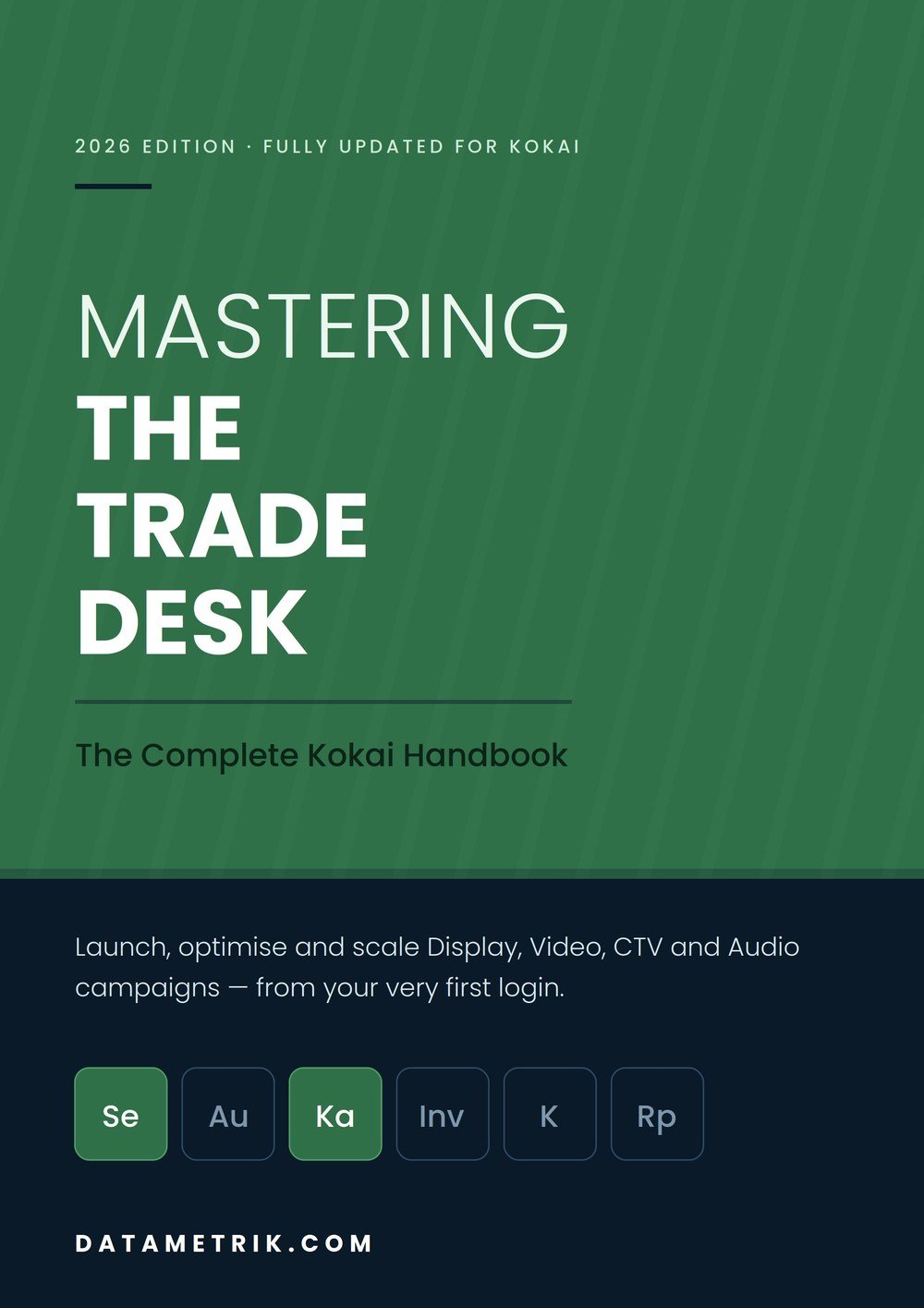
A 174-page working handbook for Kokai — every tile, six full campaign walkthroughs, the optimisation playbooks, and the troubleshooting decision tree. Written for people with a login and no colleague sitting next to them.
Until 2023 the interface was called Solimar: a row of tabs across the top — Campaigns, Data, Inventory, Reports — and you clicked a tab to get to a section.
Kokai threw that away. The tabs are gone. In their place is the Programmatic Table: a grid of tiles, each with a two-letter code, each representing one decision. You don't navigate to a section; you open a tile, make a decision, and the tile shows you its effect.
Which means every guide, blog post, YouTube walkthrough and training deck written before mid-2023 — and a surprising amount written after — is describing navigation that isn't there. If a tutorial tells you to click the Data tab and select Audiences, it's describing Solimar. Stop reading it.
And then in August 2026, Zuma moved things again.
Chapter 26 · added 2 September 2026
On 27 August 2026 The Trade Desk shipped the biggest change to Kokai since it launched — a release called Zuma. It landed six days before this edition. Chapter 26 covers it in full:
Plus a chapter-by-chapter map of what to read differently across the other twenty-five.
Everything here was drawn independently for this edition — every diagram, table and illustration. There are no screenshots, because screenshots go stale in a quarter and the concept underneath almost never does. Where a setting has moved or been renamed, the book tells you to look for the equivalent control rather than the exact label.
Six campaigns are built end to end: Display, Online Video, Connected TV, Audio, Native/DOOH/Retail Media, and a true omnichannel campaign. Not "here's what a campaign is" — the actual sequence, in order, with the numbers worked through so you can check them.
₹1,299 is one evening out. The difference is that this one is still useful on Monday.
₹1,299
About ₹7 a page — for the manual the platform doesn't ship with.
174 pages · 26 chapters · 6 walkthroughsOne-time payment · Instant PDF download · No subscription
₹1,299 + 18% GST · ₹1,533 total · delivered in seconds
Before you buy. This is an instant digital download, so all sales are final once the file has been delivered — see our Refund & Cancellation Policy. That's why the full contents, the Zuma chapter summary and the FAQ are all on this page: so you know exactly what you're getting before you pay.
Dinner is one number. Here's the one that matters more: this is a handbook for a platform where you spend other people's budgets, in real time, on inventory that can under-deliver.
One frequency cap set at the wrong level. One pacing setting left on default for a fortnight. One targeting stack so narrow it never spends. Any single one of those costs more than this book, on a campaign of any size.
That's the argument, and it's a different one from "it's cheap." A ₹5,00,000 monthly budget run 2% better is ₹10,000 a month. The book is 0.26% of that budget, once.
Trade Desk experience is one of the more portable things on a programmatic CV, because far fewer people have hands-on Kokai time than have DV360 time. An entry-level programmatic role in India pays ₹4–7 lakh; analyst and media trader roles pay ₹6–10 lakh. Being the candidate who can talk fluently about Seeds, Deal Desk and now Zuma is not a small edge.
Roughly one hour of an agency's time. Or a marketplace course recorded against an interface that has since changed twice. Neither gives you a tile directory you can keep open while you work.
Start at Chapter 1 and read straight through to Chapter 17. That's the arc: what programmatic is, what the platform looks like, how to prepare your data and inventory, then six campaigns built step by step. Do the checkpoints — four minutes each, and they're the difference between recognising something and being able to do it.
Skim Chapters 1 and 3, read Chapter 2 carefully — it explains why this platform is built differently — then go slowly through Chapter 4 and Chapter 7. Seeds have no equivalent in DV360 or Amazon DSP and they change how you set up everything downstream.
Go to Part 6. Chapters 18 and 19 are where the money is: optimisation by objective, and the granular bid controls this platform gives you and others don't. Then Chapter 10 for Deal Desk, Chapter 23 for what Koa is doing under the hood — and Chapter 26 for everything Zuma just changed.
This is a working handbook. If you have an interview booked, these are question banks with worked answers.
122 real questions from real interview rooms. DV360, The Trade Desk and RTB.
The ad server. Trafficking, tags, discrepancies, the questions ad ops teams actually ask.
Yield and the sell side. Where publisher revenue actually comes from.
The three interview handbooks — buy side, sell side, ad server. See all books →
Yes — more than anything else you'll find. The book was written for Kokai, and Chapter 26 covers the Kokai Zuma release from 27 August 2026. Where something could not be confirmed against a live seat it is marked Check in seat, so you verify it in your own account rather than take it on faith.
No. Part 1 explains programmatic in plain English before the platform appears at all, and there's a reading route written specifically for people starting cold. The checkpoints tell you honestly whether it's landing.
Yes, and Chapter 7 is why. Seeds have no equivalent in either platform, and they change how you build everything downstream. Chapter 19's granular bid controls are the other thing this platform does that the others don't.
A full walkthrough, plus Audio, Native, DOOH and Retail Media, and a true omnichannel campaign built across all of them.
No, deliberately. Screenshots date within a quarter and can't be redistributed. Every diagram and table was drawn independently for this edition, and navigation is given as a path so it still resolves when a label moves.
No — Gumroad adds 18% GST at checkout for Indian buyers, so the total is ₹1,533. Gumroad collects and remits it.
Yes. The Zuma chapter is exactly that — added after publication and delivered free to everyone who already bought. The platform will keep moving; you shouldn't have to buy the book twice.
Digital files can't be un-delivered, so sales are final — with the exceptions in our Refund & Cancellation Policy: non-delivery, a corrupted file, a duplicate charge, or the wrong product. Email us within 7 days.
It will make you fluent, which is most of it. But if you have an interview booked, Cracking the Programmatic Interview is the book built for that job — real questions, with the answers.
No. The Trade Desk, Kokai, Koa, Solimar, Sincera, Unified ID 2.0 and OpenPath are trademarks of The Trade Desk, Inc., used here only to identify the platform this book describes. Independent study guide, not endorsed by or sponsored by them. See our Disclaimer.
The licence covers one reader — see our Terms of Service. Get in touch for a team licence.
Instant PDF · 174 pages · includes the Kokai Zuma chapter · ₹1,299 + 18% GST · ₹1,533 total
More on the platform in the free Trade Desk and programmatic archives.
More from Datametrik:
Access all popular ebooks here· New to programmatic? Start with the Kokai Programmatic Table explained · Want it done for you? See our programmatic and paid media services · Browse all our ebooks.