Meta Ads Interview Questions and Answers (2026)
Datametrik / Interview Handbook Series · First Edition · Updated August 2026
Meta Ads Interview Questions and Answers (2026)
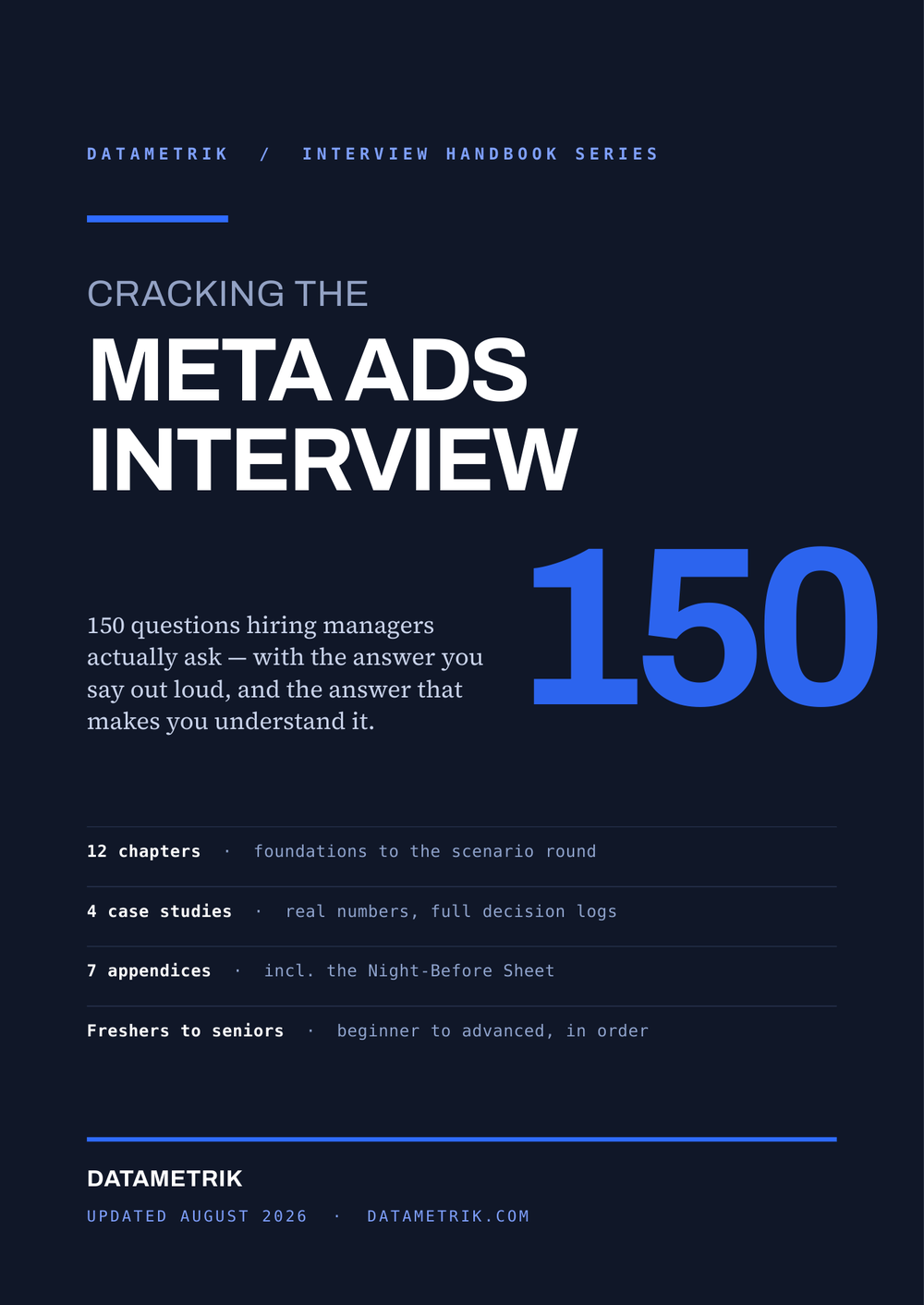
150 Meta Ads interview questions hiring managers actually ask — each one answered five ways: the answer you say out loud, the plain-English version underneath it, the numbers worked in rupees, the follow-up they will ask next, and the red-flag answer that gets you rejected.
+ tax, added at checkout. Gumroad is the merchant of record and collects applicable tax on digital goods — so the final amount is ₹1,299 plus tax, not a surprise fee afterwards.
UPI · Cards · Net banking | Instant download, PDF + EPUB
Free lifetime updates at the same link
Written for
Meta Ads interview questions for performance marketing, paid social and media buying roles
The same 150 questions come up whether the job title says Performance Marketer, Paid Social Specialist, Media Buyer or Growth Marketer. These are the rooms this book was written for.
Performance Marketing Executive
Agency and in-house. Chapters 1, 2 and 5 are the screening call; Chapter 7 is the second round.
Paid Social / Meta Ads Specialist
Creative strategy, testing frameworks and Advantage+ — Chapters 4 and 5 carry the interview.
Media Buyer & Growth Marketer
Budget models, scaling rules and unit economics. Chapters 5 and 6, then the scenario round.
D2C / E-commerce Marketing
ROAS, breakeven ROAS, POAS, catalogs and Advantage+ Catalog Ads. Chapters 1, 5 and 9.
Digital Marketing Manager
Client communication, attribution expectations and the bad-month conversation. Chapter 9 and Chapter 12.
Freshers & career switchers
Certificate but no live account. The In Plain English block on all 150 questions was written for you.
Why good candidates get rejected
You can run the account. The interview is a different test.
Almost every rejection in a Meta Ads interview happens in the first ten minutes, and almost none of them are because the candidate did not know something advanced. They happen because the candidate used a word loosely — said “reach” when they meant impressions, or quoted a ROAS without knowing whether the client makes money at it.
What actually gets people rejected
- Quoting a ROAS with no idea what the client’s breakeven ROAS is — the single most common miss in D2C interviews
- Saying “manual versus Advantage+” as if that is still the question, eighteen months after it stopped being one
- Not knowing about the March 2026 click attribution split, and calling a reporting change a performance drop
- Describing the pixel without mentioning its second job — feeding the training examples delivery learns from
- Explaining deduplication without naming the two fields it matches on
- Guessing a cause in a troubleshooting question instead of narrowing the scope in order
- Answering “how would you scale this” with “increase the budget” and stopping
What this book fixes
- A script for every answer. Sixty to a hundred and thirty words, written to be said out loud, not read.
- The plain-English version underneath it — so when they push and ask “but why?”, you are not standing on a memorised sentence with nothing beneath it.
- The follow-up they will ask next, written out. First answers are prepared. Second answers are where interviewers find out whether you understood what you just said.
- The red-flag answer, quoted, so you can hear yourself about to say it.
- The arithmetic, worked in rupees. Being able to do one of these out loud puts you ahead of most of the room.
- Current as of August 2026. The attribution split, Advantage+ Sales, Andromeda, pLTV bidding and Threads as a placement.
How every question is answered
Five layers on every one of the 150 questions
You do not need all five every time. The Interview Answer is the script. The other four are there for the moment the interviewer does not stop at the first answer.
The Interview Answer
Sixty to a hundred and thirty words, written to be spoken. Read it out loud at least once — it is built for the mouth, not the eye.
In Plain English
The same idea with an everyday analogy and no jargon. If the interview answer went past you, this is the one that fixes it.
The Numbers
A worked example with real figures, mostly in rupees. Doing one of these calculations out loud puts you ahead of most candidates.
The Follow-Up They’ll Ask
The second question, which is where most candidates come apart. First answers are prepared; second answers are where they find out if you understood it.
Red Flag Answer
The answer that gets you rejected, quoted, so you can hear yourself about to say it. These are real weak answers, not strawmen.
Here is a real, unedited question from the book
Not a teaser. This is exactly what all 150 look like. Question 2 of 150, from Chapter 1.
Question 2 · Chapter 1, Foundations
What campaign objectives are available in Ads Manager, and how do you choose the right one?
The Interview Answer · say this out loud
Six: Awareness, Traffic, Engagement, Leads, App promotion and Sales. The choice isn’t about what I want in the abstract — everyone wants sales. It’s about which event I can actually feed the algorithm reliably. Meta optimises towards the event I choose, so if I pick Sales I need purchase events firing consistently and in enough volume to learn from. If a brand has three purchases a week, Sales will starve and I’d run Leads or optimise on a higher-funnel event until volume supports it. So the rule I use is: pick the objective closest to the money that still gives the algorithm enough signal to learn from.
In Plain English
You’re telling Meta what to go and find. Ask for website visits and you get people who like clicking. Ask for purchases and you get people who buy — but only if Meta can see enough purchases to know what a buyer looks like. Asking for something it can’t measure is like sending someone shopping without telling them what the item looks like.
The Numbers
A working threshold: an ad set wants roughly 50 optimisation events per week to exit the learning phase cleanly. If the client sells a ₹40,000 product and converts twice a week, a Sales objective on Purchase will never get there — that’s the moment you move up the funnel to Lead or Initiate Checkout and let the sales team close.
The Follow-Up They’ll Ask
“A client insists on the Sales objective when the data doesn’t support it. What do you do?”
“I don’t argue about the objective, I argue about the event. I’d agree the goal is sales, then show them that on current volume the algorithm gets one signal every three days and can’t learn from that. I’d propose optimising on a strong mid-funnel event for four to six weeks, prove the correlation to sales in their own CRM, and move to purchase optimisation once volume is there. Same goal, a route the platform can actually run.”
Red Flag Answer
“I always use the Sales objective because that’s what the client wants.” — This tells the interviewer you’ve never run a low-volume account. Objective choice is a data question, not a preference question.
Instant download · PDF + EPUB · Free lifetime updates
Free sample · no email required
12 Meta Ads interview questions with short answers
These twelve are taken from the Night-Before Sheet in Appendix A — every one of the 150 questions reduced to the single line that carries the answer. Read them now. If you can already say all twelve out loud without looking, you are further along than you think. If three of them stop you, that is what the book is for.
Question 1
What are the three levels of a Meta Ads campaign, and what does each control?
Campaign sets the objective, the special ad category and the budget if you are on Advantage+ Campaign Budget. Ad set sets audience, placements, schedule, optimisation event and bid strategy. Ad sets the creative, copy, headline and destination. The hierarchy doubles as a diagnostic map: a delivery problem lives at ad set level, a relevance problem at ad level, an objective problem at campaign level.
Question 4
How do CPM, CPC, CTR and CVR drive CPA?
CPM is the price of attention, CTR is the share who click, CVR is the share who convert. CPC = CPM ÷ (CTR × 1,000), and CPA = CPC ÷ CVR — so doubling CTR halves CPA. When CPA moves, one of those four moved, and naming which one is the whole diagnosis.
Question 6
What is the difference between ROAS, breakeven ROAS and POAS?
ROAS is attributed revenue ÷ spend and ignores fulfilment cost. Breakeven ROAS is 1 ÷ contribution margin — at a 55% margin, breakeven is 1.82x. POAS puts gross profit on top instead of revenue. Optimise on ROAS, target on breakeven, scale on POAS. A 4x ROAS on a 20% margin account is losing money, and saying so is what separates a marketer from a button-pusher.
Question 9
How does Meta’s ad auction actually work?
It is not the highest bidder. Meta ranks total value = bid × estimated action rate + ad quality, and the winner pays just enough to beat the runner-up. The practical consequence is the one to say out loud: good creative beats a bigger budget, because a high estimated action rate lets you win the same impression at a lower bid.
Question 17
What is the Meta pixel, and what is its second job?
It is website code reporting visitor actions back to a Meta dataset. It has two jobs, and most candidates only name the first. Job one is measurement. Job two — the bigger one — is supplying the training examples that delivery learns buyers from. Browser-only collection is now partial, which is why the Conversions API is not optional.
Question 20
What is the Conversions API, and how is it different from the browser pixel?
CAPI sends the same events from a server rather than the browser, so it survives ad blockers, consent prompts and closed tabs, and it can carry offline and CRM sales the browser never sees. The correct answer is never “CAPI instead of the pixel” — you run both and deduplicate.
Question 22
How does deduplication work, and which two fields does it match on?
Both copies of the event must share an identical event_name and the same event_id — usually the order ID. Get either one wrong and Meta keeps both, which inflates revenue and teaches value bidding double. This is the question most candidates answer half of.
Question 28
What changed with click attribution in March 2026?
Click-through now counts link clicks only. Likes, comments, shares, saves and video views moved into a separate one-day engage-through bucket, and the video threshold for counting as an engagement dropped from ten seconds to five. Reported click conversions fell on a lot of accounts — but the response was accounting, not media. Being unaware of this is the fastest way to sound like you last worked on the platform in 2024.
Question 56
What is Andromeda, and how did it change creative strategy?
Andromeda is Meta’s ads retrieval system, rolled out from late 2025. It reads the creative itself — images, frames, content — to narrow a huge pool of eligible ads to a shortlist before ranking picks the winners. Four consequences worth stating: creative now decides which ads enter the auction at all; conceptual diversity beats variation, because near-duplicates get collapsed and compete with each other; fatigue arrives in two to three weeks rather than six; and one ad set holding many genuinely different creatives beats several small ad sets.
Question 68
What is the learning phase, and what triggers Learning Limited?
An ad set wants roughly 50 optimisation events per week to exit learning cleanly. Learning Limited means it cannot get there — usually because the budget is too low for the target CPA, the audience is too narrow, or the account is fragmented across too many small ad sets. The fix is almost always consolidation, not another new ad set.
Question 97
CTR is high and conversion rate is near zero. What is your diagnosis?
Rule out tracking first, always — if you skip that step everything after it is guesswork. Then split the funnel: if CTR is healthy and site CVR is flat, the problem is downstream of the click, which means the landing page, the offer or a mismatch between what the ad promised and what the page delivers. Interviewers mark the order you check things in, not the cause you land on.
Question 107
Meta says 15 purchases, GA4 says 8. Which one is right?
Both, because they are answering different questions. Meta is view-through and click-through credited to the ad, on the day of the interaction, with a meaningful modelled share. GA4 is last non-direct click, on the day of the sale. Neither is the rupee. The correct answer names the backend or CRM as the scoreboard, Meta as directional for media decisions, and a holdout test as the only thing that proves causation.
Those twelve are the one-line versions. In the book each one gets the full spoken script, the plain-English version, the numbers, the follow-up and the red flag.
What’s inside
Twelve chapters, beginner to advanced, in the order you should learn them
Each chapter assumes only what came before. Chapter 1 assumes nothing. Chapter 10 assumes all nine before it.
Questions 1–16
Foundations: the language of Meta Ads
Campaign structure, the six objectives, reach vs impressions, CPM/CPC/CTR/CVR, ROAS vs breakeven ROAS vs POAS, AOV/LTV/CAC, how the auction works, estimated action rate, ad quality, the three ad rankings, audiences, placements, catalogs, and optimisation vs billing vs attribution.
Questions 17–32
Tracking & measurement: pixel, CAPI, attribution
The pixel and its second job. Standard, custom and custom conversion events. Four ways to implement CAPI. Deduplication. Event Match Quality. Hashing and normalisation. Aggregated Event Measurement and the eight-event limit. Domain verification. Attribution windows, the March 2026 click split, view-through, incremental attribution, lift tests vs A/B tests, and how much of Ads Manager is modelled.
Questions 33–46
Targeting & audiences
Custom Audience sources and which seed is strongest. Value-based Lookalikes. Lookalike percentages and stacking. Broad vs interests on a small budget. Audience overlap and self-cannibalisation. Advantage+ Audience vs detailed targeting expansion. Special Ad Categories. Day one with no pixel and no customer list. Hyper-local strategy for a restaurant, gym or clinic.
Questions 47–64
Creative strategy & testing
Platform-native creative and aspect ratios. Safe zones on Reels. What makes three seconds work. A framework for structured creative testing. Built-in A/B vs a manual split. Andromeda and how creative delivery changed. Creative similarity and self-suppression. Fatigue signals and refresh cadence. Frequency caps. Using the Ads Library on competitors. UGC vs studio vs static vs VSL.
Questions 65–82
Campaign setup & media buying
CBO and ABO mechanically, and choosing between them on a live account. Daily vs lifetime budget. The learning phase and Learning Limited. Which edits reset learning. Cost cap, bid cap, highest volume and ROAS goal. Calculating a starting cost cap from unit economics. Advantage+ Sales and Leads vs manual structures, and what changed in 2026. Instant Form vs landing page. Dayparting and pacing at high budget.
Questions 83–96
Optimisation & scaling
Kill or scale. Horizontal vs vertical scaling. How much you can raise a budget and how often. Duplicate the winner or raise its budget. Daily KPIs for e-commerce vs lead gen. Leading indicators that predict a winner early. Optimising when conversion volume is too low to read. Value optimisation and pLTV thresholds. Pacing a festive peak on an Indian account. The first 72 hours on a new account.
Questions 97–112
Troubleshooting & diagnostics
Sixteen diagnostic scenarios, each with the order you check things in. High CTR and dead conversions. An overnight drop across the account. A proven ad doubling its CPA in 48 hours. A CPM spike with nothing changed. Verifying deduplication. Stuck in review or Not Delivering. High lead volume with no qualified leads. Meta vs GA4 vs the CRM. Reach collapsing while spend holds steady. A healthy dashboard and falling sales.
Questions 113–122
Policy, compliance & account health
Why ads and accounts get rejected, and your first move. Misleading claims and restricted verticals. The personal attributes rule, with three examples fixed. Circumventing Systems and Unrealistic Outcomes. Appealing a rejection and what to do when it fails. Emergency protocol for a restriction before a launch. Business verification. Protecting client assets: roles, two-factor and ownership.
Questions 123–132
Reporting, analytics & client communication
Why UTMs are needed when the pixel exists, and a UTM structure that survives BI tools. Meta’s dynamic URL parameters. MER and blended ROAS. A weekly report a non-marketer actually reads. Agreeing a north-star metric at kickoff. 4x on the dashboard with profit falling. Explaining 15 purchases against 8. Presenting a bad month without losing the account.
Questions 133–150
The scenario round: think like a media buyer
Eighteen full scenarios with the reasoning written out. Daily budget gone by noon converting nothing. A winning video’s CPA doubling in a fortnight. ROAS from 2.5x to 1.6x on a ₹40L account. Real estate leads at ₹1,200 but 80% junk. A 30-day roadmap for a messy inherited portfolio. Account restricted the day before launch. Preparing for a 5x Diwali budget spike. A site migration that killed the pixel for nine days.
Four case studies
Real numbers, full decision logs
A D2C skincare fatigue collapse (₹8L/month, ROAS 2.9x to 1.7x in nine days, with the week-by-week recovery and the honest ending). Four gyms and cheap leads that never walked in. A B2B SaaS account on nine conversions a week. An account takeover. Each one ends with How to tell this in ninety seconds — the version you say in the room.
The round nobody prepares for
Behavioural questions, portfolio and salary
Tell me about yourself. Your most expensive mistake. Delivering bad news and keeping the account. How to talk about an account you cannot screenshot. And the money conversation, written out.
Seven appendices — the part you actually keep
A · The Night-Before Sheet
All 150 questions reduced to the single line that carries the answer. Short enough to read end to end on the way to the interview.
B · Every formula, worked
CPA, ROAS, breakeven ROAS, POAS, frequency, MER, cost cap from unit economics — each one with the arithmetic shown.
C · Benchmarks, and how to use them
Including how to use a benchmark without getting caught out by one, which is the part that gets asked.
D · Glossary
Every term in the book defined in one line, for the fortnight before you are fluent.
E · The 30-Day Account Audit
What to check, in order, in your first month in the job. This is the appendix that keeps you looking competent after you are hired.
F · Three mock interviews
Full transcripts at fresher, mid and senior level, so you can hear the shape of a whole conversation rather than single answers.
G · What changed in 2026
Two pages. The March 2026 attribution split, Advantage+ Sales as the default, Andromeda, pLTV bidding and Threads as a real placement — each with the one-sentence version you can say in a lift. Naming one of these accurately is the fastest way to signal you work on the platform rather than having studied it.
Who this is for
Four people, and the book is sequenced so all four use the same pages
Breaking in
The fresher with a certificate and no live account
You have never seen a real Ads Manager and you are dreading the scenario round. Read everything — the In Plain English blocks were written for you, and Chapter 10 is the round you are afraid of, rehearsed eighteen times.
Levelling up
One to three years, competent, freezes on “why?”
You run campaigns properly and lock up when asked to explain the mechanism. Your gap is Chapters 2, 6 and 9. Start there and come back.
Switching jobs
The senior after three years inside one account
Your risk is sounding current, not sounding capable. Read Appendix G first, then Questions 28, 56, 57, 75 and 92 — the five places where a 2024 answer is most visible.
Crossing over
The switcher from SEO, content or sales
Read in order, all of it, and give yourself the thirty days. Appendix E turns the reading into something you can talk about rather than something you have read.
Three routes through it, depending on how much time you have
Route 1 · 48 hours
Two evenings. Interview Answer blocks only, in a specific order — about 55 questions and roughly three hours. It will not make you senior. It will stop you freezing.
Route 2 · 7 days
Two chapters a day, in order, reading the Interview Answer and In Plain English blocks. Day six is the case studies. Day seven is the mock interviews, out loud.
Route 3 · 30 days
Five to six questions a day, every block, in order, with the 30-Day Account Audit running on a real or practice account. This is the route that changes what you can do, not just what you can say.
One honest limitation
This will not get you a job you are not ready for
It cannot give you the two years of account experience a senior media buyer role genuinely requires, and any book claiming otherwise is selling you something. What it will do is make sure you are never rejected for a reason that was fixable — a term you used loosely, a follow-up you had not thought about, a diagnostic you could not sequence, a 2026 change you had not heard of. That is a large share of rejections, and it is the share you control.
Who this is for
Four people, and the book is sequenced so all four use the same pages
Breaking in
The fresher with a certificate and no live account
You have never seen a real Ads Manager and you are dreading the scenario round. Read everything — the In Plain English blocks were written for you, and Chapter 10 is the round you are afraid of, rehearsed eighteen times.
Levelling up
One to three years, competent, freezes on “why?”
You run campaigns properly and lock up when asked to explain the mechanism. Your gap is Chapters 2, 6 and 9. Start there and come back.
Switching jobs
The senior after three years inside one account
Your risk is sounding current, not sounding capable. Read Appendix G first, then Questions 28, 56, 57, 75 and 92 — the five places where a 2024 answer is most visible.
Crossing over
The switcher from SEO, content or sales
Read in order, all of it, and give yourself the thirty days. Appendix E turns the reading into something you can talk about rather than something you have read.
Three routes through it, depending on how much time you have
Route 1 · 48 hours
Two evenings. Interview Answer blocks only, in a specific order — about 55 questions and roughly three hours. It will not make you senior. It will stop you freezing.
Route 2 · 7 days
Two chapters a day, in order, reading the Interview Answer and In Plain English blocks. Day six is the case studies. Day seven is the mock interviews, out loud.
Route 3 · 30 days
Five to six questions a day, every block, in order, with the 30-Day Account Audit running on a real or practice account. This is the route that changes what you can do, not just what you can say.
One honest limitation
This will not get you a job you are not ready for
It cannot give you the two years of account experience a senior media buyer role genuinely requires, and any book claiming otherwise is selling you something. What it will do is make sure you are never rejected for a reason that was fixable — a term you used loosely, a follow-up you had not thought about, a diagnostic you could not sequence, a 2026 change you had not heard of. That is a large share of rejections, and it is the share you control.
Let’s talk about ₹1,299
It costs less than the things you buy without thinking about them
You are preparing for a role where a single band change commonly moves your annual package by lakhs, and where one rejected final round costs you weeks. Here is what ₹1,299 is actually competing with in your month.
| What you already spend it on | Roughly |
|---|---|
| One dinner for two, ordered in on a Friday | ₹1,200–1,800 |
| Your month of daily coffee (₹120 × 13 working days) | ₹1,560 |
| Netflix + Spotify + Prime, for one month | ₹1,100+ |
| One movie night for two, with popcorn | ₹1,400+ |
| One Udemy course you will open twice | ₹2,000–3,500 |
| One paid resume review | ₹2,000+ |
| One hour with a performance marketing mentor | ₹3,500+ |
| One weekend of Swiggy and Zomato | ₹1,500+ |
| This book — 150 questions, 396 pages, yours forever | ₹1,299 |
That is ₹10 per question.
Ten rupees for an answer a hiring manager will grade you on, written out in the exact words you say, with the follow-up they ask next and the wrong version that ends the interview. If one of the 150 lands well in the room, the book has paid for itself several thousand times over.
What ₹1,299 actually buys you
- 150 scripts you can say out loud — not bullet points you have to turn into sentences under pressure.
- 150 follow-up questions, answered. The second question is where interviews are lost, and almost nobody prepares for it.
- 150 red-flag answers, quoted, so you hear yourself about to say one.
- 18 full scenarios and 4 case studies with real numbers — the material you use when they say “tell me about a time” and you have nothing to screenshot.
- Three mock interviews at fresher, mid and senior level.
- A 30-day account audit that keeps you looking competent in the first month of the job, which is the other half of getting hired.
- Free lifetime updates. Meta rewrites itself roughly every eighteen months; every future edition appears at the same download link.
And what it costs to skip it
One rejected final round costs you weeks of searching, another round of applications, and — if you take a lower offer because a better one slipped — a salary base you will carry for years. Against that, the download is the cheap part.
Instant access · PDF + EPUB · UPI, cards and net banking
In the box
What lands in your inbox, thirty seconds from now
File 1
The 396-page PDF
Properly typeset, colour-coded by answer layer, with a clickable contents page and PDF bookmarks so you can jump to any of the 150 questions. Prints cleanly.
File 2
The EPUB edition
Reflowable, for Kindle, Apple Books, Google Play Books and your phone. Read the Night-Before Sheet on the way to the interview.
Built in
The Night-Before Sheet
All 150 answers in one line each. Print it, fold it, take it with you.
Built in
Three study routes
48 hours, 7 days or 30 days — designed for the time you actually have, not the month you wish you had.
Built in
The 30-day account audit
What to check, in order, in your first month in the role. Turns reading into something you can talk about.
Forever
Free lifetime updates
Every future edition appears at the same download link you already have. Nothing to claim, nothing to buy again.
About the author
Written by Datametrik Team, Datametrik
Datametrik Team has spent the last several years running paid media and measurement work across Meta Ads, Google Ads, DV360, Campaign Manager 360 and The Trade Desk for D2C, lead-generation and B2B accounts, and writes the ad tech and performance marketing guides at Datametrik. Several of the red-flag answers in this book are things the author has said in an interview.
How this book was built. Every one of the 150 questions is one that has actually been asked in a Meta Ads interview, collected from hiring rounds on both sides of the table. Every platform claim was verified against live Ads Manager behaviour in August 2026, and where an answer depends on current platform behaviour it is flagged in the text so you can re-check it before you quote it in a room. The numbers in the worked examples are real account figures with client details removed.
Last updated: August 2026 · First edition · Meta, Facebook, Instagram, Messenger, Threads and Ads Manager are trademarks of Meta Platforms, Inc. This is an independent study guide and is not affiliated with, endorsed by or sponsored by Meta Platforms, Inc.
Before you buy
Fair questions about the Meta Ads interview handbook
Is this current for 2026, or recycled from an old blog post?
Current, and deliberately so. Platform behaviour was verified in August 2026. It covers the March 2026 click attribution split (link clicks only, with engage-through moved to a separate one-day bucket), Advantage+ Sales becoming the default rather than an option, Andromeda and what it did to creative strategy, pLTV bidding and its volume thresholds, and Threads as a real placement. Those are exactly the topics where a stale answer is most visible in a room — and where being precise makes you sound more current than most interviewers.
I am a fresher with no hands-on Ads Manager access. Is this useful?
Yes, and the book is sequenced for you. Every question has an In Plain English block written with an everyday analogy and no jargon, so you can understand the mechanism before you have ever seen the interface. Chapter 10’s eighteen scenarios and Appendix F’s three mock interviews are specifically there to give you something to say when you cannot draw on your own accounts. What it will not do is fake two years of experience for you.
My interview is tomorrow morning. Is it too late?
No. Start at “Read this if your interview is tomorrow” on page 4 and take Route 1 — about 55 questions and roughly three hours, in a specific order. Then read Appendix A, the Night-Before Sheet, tonight and again on the way in. It will not make you senior by morning. It will stop you freezing.
How is this different from your DV360, CM360 and supply-side books?
Completely different platform and a different interview. The DV360 handbook is programmatic buy-side trading, the CM360 and Ad Ops handbook is ad serving and attribution, and the supply-side handbook is publisher monetization and yield. This one is Meta Ads end to end — pixel, CAPI, audiences, creative, Advantage+, scaling, diagnostics and the scenario round. There is no meaningful overlap. If you are interviewing for a performance marketing or paid social role, this is the only one of the four you need.
Is it only relevant for people interviewing in India?
The mechanics are global — the auction, the pixel, CAPI, Advantage+, the learning phase and the diagnostics work identically wherever you are. The worked examples use rupees and a few scenarios are India-specific (the Diwali budget spike, hyper-local targeting for an Indian gym or clinic). If you are interviewing elsewhere, the arithmetic transfers exactly; only the currency symbol changes.
What format is it, and can I print it?
PDF and EPUB, both included. The PDF is typeset for reading on a laptop and prints cleanly — the Night-Before Sheet and the formula appendix are designed to be printed and carried. The EPUB reflows for Kindle, Apple Books, Google Play Books and your phone. No DRM, no app, no login.
Why does the total at checkout look higher than ₹1,299?
Because Gumroad is the merchant of record and collects applicable tax on digital goods in your country. The book is ₹1,299; tax is added on top at checkout and shown before you pay. Nothing is charged afterwards.
What is the refund policy?
Digital products are non-returnable once downloaded, but if the file is corrupt, the wrong file, or genuinely not what the page described, write to us and it is sorted. Full terms are on the refund and cancellation policy page, and you can reach us through contact us.
Will it be updated, and do I pay again?
It will be updated, and you do not pay again. Meta rewrites meaningful parts of the platform roughly every eighteen months. Every future edition appears at the same Gumroad download link you already have — nothing to claim, nothing to re-purchase.
Can I buy it for my team?
Yes. The licence is one reader per copy, so for a team buy the number of seats you need — and if you want more than five, get in touch and we will sort out a team rate and a single invoice. Hiring managers: the 150 headings are a ready-made technical question bank and the Red Flag blocks work as a scoring rubric.
More from Datametrik
If you are preparing for a performance marketing interview, read these too
Free guides and companion question banks from our ebooks collection and blog.
150 questions. 396 pages. ₹1,299.
Every answer written to be said out loud — with the plain-English version underneath it, the numbers worked, the follow-up they ask next, and the red-flag answer named, so the second question does not catch you.
Get the handbook — ₹1,299 + tax₹1,299 + tax · Instant download · PDF + EPUB · Free lifetime updates
Not affiliated with, endorsed by or sponsored by Meta Platforms, Inc. Meta, Facebook, Instagram, Messenger, Threads and Ads Manager are trademarks of Meta Platforms, Inc.
Questions first: contact us · refund policy · terms · all ebooks