DV360 interviews test three things.
Platform basics, hands-on setup, and troubleshooting.
Freshers get asked about hierarchy, Floodlight and viewability.
Mid-level roles get pacing, bidding and audiences.
Senior roles get broken campaigns and measurement questions.
Below are 15 real questions with simple, interview-ready answers.
Last updated: November 24, 2026. Written by the Datametrik team. Questions come from candidates and practitioners who recently interviewed.
Preparing for a DV360 interview?
Most free lists online give one-line definitions.
Real interviews go deeper.
They ask why, when, and what you would do next.
These 15 questions come from the same pool as our DV360 interview book.
That book collects questions from 40+ practitioners who recently interviewed.
Each answer here is short, simple, and ready to say out loud.
Table of contents:
- Fresher DV360 interview questions
- 1–3 years DV360 interview questions
- Senior DV360 interview questions
- How to prepare
- Get all 122 questions
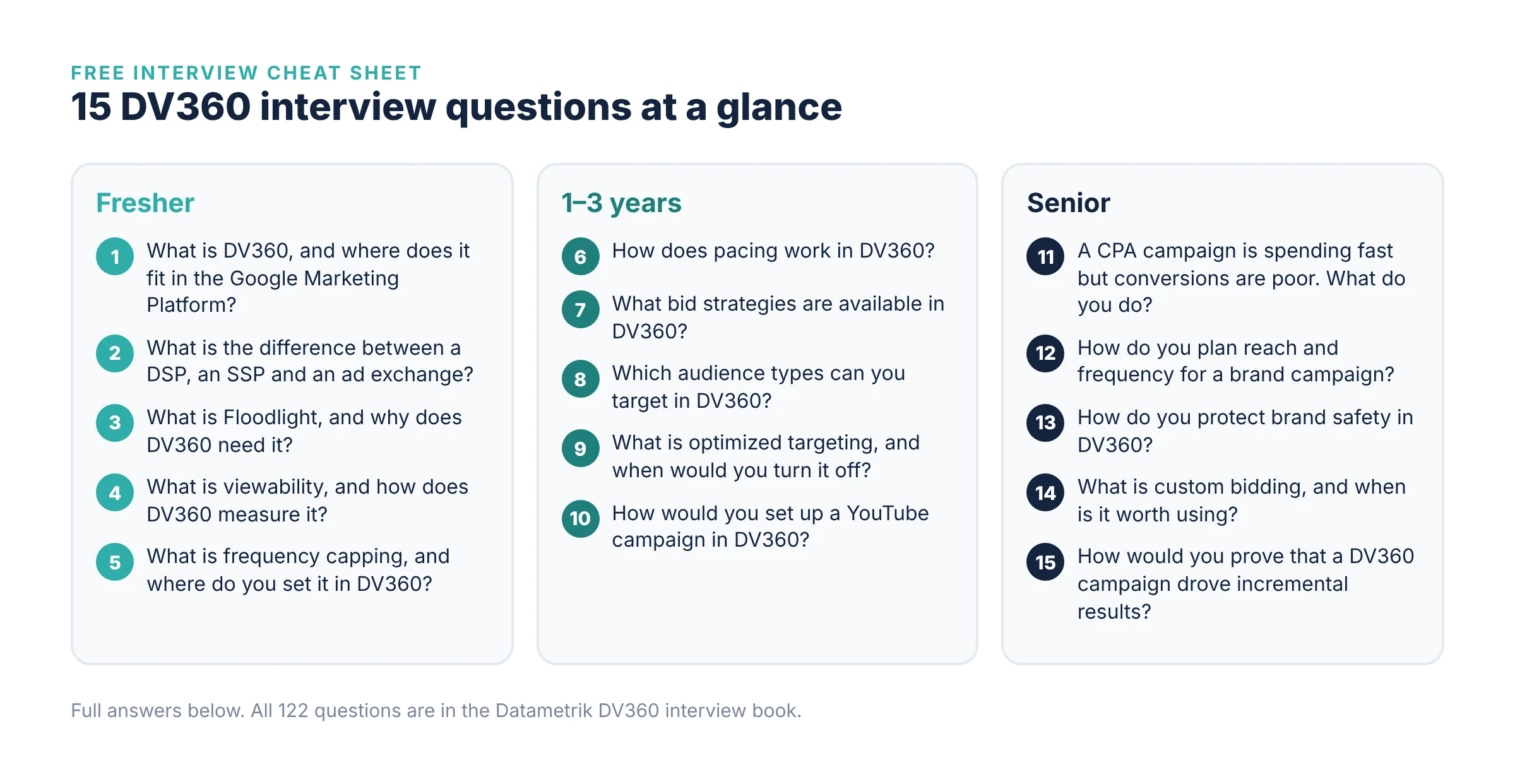
All 15 questions at a glance. Full answers are below.
Fresher DV360 interview questions
Q1. What is DV360, and where does it fit in the Google Marketing Platform?
Fresher
DV360 stands for Display & Video 360.
It is Google’s demand-side platform, or DSP.
Advertisers use it to buy display, video, audio and CTV ads programmatically.
It sits next to Campaign Manager 360, Search Ads 360 and GA4.
Together they share audiences, conversions and reporting.
Testing: Do you understand where DV360 sits in the wider ad tech stack?
Q2. What is the difference between a DSP, an SSP and an ad exchange?
Fresher
A DSP works for buyers.
It decides which impressions to bid on, and how much.
An SSP works for publishers.
It helps them sell inventory at the best price.
An ad exchange is the marketplace where bids meet.
Today many SSPs run their own exchange, so the lines blur.
Testing: Can you explain both sides of the market, not just the buy side?
Q3. What is Floodlight, and why does DV360 need it?
Fresher
Floodlight is the conversion tracking system in CM360 and DV360.
You place Floodlight tags on key website pages.
For example, a thank-you page after a purchase.
DV360 uses this data to report conversions.
Automated bidding also uses it to find people likely to convert.
Testing: Do you know how conversions actually get into the DSP?
Q4. What is viewability, and how does DV360 measure it?
Fresher
Viewability tells you if an ad had a chance to be seen.
DV360 measures it with Google’s Active View.
The common display standard is 50% of pixels in view for one second.
For video, it is 50% of pixels for two continuous seconds.
This standard comes from the Media Rating Council, or MRC.
Testing: Do you know the standard, not just the word?
Q5. What is frequency capping, and where do you set it in DV360?
Fresher
A frequency cap limits how often one person sees your ads.
For example, three times per week.
In DV360, you can set caps at campaign, insertion order and line item level.
The strictest cap always wins.
Caps protect user experience and stop budget waste on the same people.
Testing: Do you know caps stack across levels?
Our DV360 & Programmatic Interview Questions and Answers has all 122 questions with full answers.
Each answer comes with an easy version to say out loud.
Not ready to buy? Try the free DV360 mock test first.
1–3 years DV360 interview questions
Q6. How does pacing work in DV360?
1–3 years
Pacing controls how fast budget is spent across a flight.
“Evenly” spreads spend across the flight.
“Ahead” spends a little faster early, to avoid underspend.
“As soon as possible” spends quickly, with no smoothing.
Most brand campaigns use Evenly or Ahead.
Read more in our DV360 pacing guide.
Testing: Can you match pacing to the campaign goal?
Q7. What bid strategies are available in DV360?
1–3 years
You can use a fixed bid, where you set one CPM.
Or you can use automated bidding.
Automated bidding can maximise a goal, like conversions or viewable impressions.
It can also aim for a target, like a CPA or CPC.
Advanced teams use custom bidding to score impressions with their own rules.
See our guide to optimising DV360 for CPA.
Testing: Do you know when to trust automation, and when to hold control?
Q8. Which audience types can you target in DV360?
1–3 years
Google audiences, like affinity and in-market segments.
First-party audiences, from Floodlight, Customer Match or linked GA4.
Third-party data where available in your market.
Combined audiences, which mix segments with AND, OR and NOT logic.
Lookalike-style expansion through optimized targeting.
Testing: Can you build an audience strategy, not just list segments?
Q9. What is optimized targeting, and when would you turn it off?
1–3 years
Optimized targeting lets DV360 find people beyond your chosen audiences.
It uses your conversion signals to look for similar users.
It helps performance campaigns scale.
Turn it off when reach must stay strictly inside a defined audience.
For example, a CRM-only campaign or a strict brand safety plan.
Our optimized targeting guide covers this in detail.
Testing: Do you understand the trade-off between scale and control?
Q10. How would you set up a YouTube campaign in DV360?
1–3 years
Create a YouTube & partners line item under an insertion order.
Pick the goal, like reach, views or conversions.
Choose formats, such as skippable in-stream, bumper or in-feed ads.
Build ad groups with targeting and creatives.
Set a frequency cap to control repeat views.
See our DV360 YouTube reach guide.
Testing: Have you actually built YouTube line items, or only display?
Our DV360 & Programmatic Interview Questions and Answers has all 122 questions with full answers.
Each answer comes with an easy version to say out loud.
Not ready to buy? Try the free DV360 mock test first.
Senior DV360 interview questions
Q11. A CPA campaign is spending fast but conversions are poor. What do you do?
Senior
First, check tracking.
Are Floodlight tags firing, and is the conversion window correct?
Next, look at inventory and placement reports for junk sites or apps.
Then check audiences and optimized targeting for wide, low-quality expansion.
Check if the bid strategy has enough conversion data to learn.
Fix the biggest leak first, then let the algorithm settle.
Testing: Do you troubleshoot in a logical order, starting with data?
Q12. How do you plan reach and frequency for a brand campaign?
Senior
Start with the audience size and the business goal.
Use DV360’s planning tools to forecast reach at different budgets.
Pick a weekly frequency cap that fits the goal.
Too low wastes reach, and too high annoys people.
Track unique reach and average frequency weekly, then adjust.
Use a brand lift study to prove the impact.
Testing: Can you link media metrics to brand outcomes?
Q13. How do you protect brand safety in DV360?
Senior
Use digital content labels and sensitive category exclusions.
Add site and app exclusion lists, or inclusion lists for strict brands.
Use a verification partner like IAS or DoubleVerify.
Prefer authorised sellers using ads.txt and sellers.json.
Review placement reports every week.
More in our brand safety guide.
Testing: Do you protect the brand without killing scale?
Q14. What is custom bidding, and when is it worth using?
Senior
Custom bidding lets you tell DV360 what an impression is worth.
You write a script or rules based on your own goals.
For example, valuing high-margin products more.
It needs enough conversion data to work well.
Use it when standard goals do not match your real business value.
Testing: Can you move beyond default settings when the business needs it?
Q15. How would you prove that a DV360 campaign drove incremental results?
Senior
Run a controlled test with a holdout group.
DV360 experiments let you split users between variants.
Brand lift studies measure awareness or consideration changes.
Compare test and control, not just attributed conversions.
Read our guides on DV360 A/B tests and brand lift studies.
Testing: Do you know the difference between attribution and incrementality?
How to prepare for a DV360 interview
Reading answers is not enough.
You need to say them out loud, under a little pressure.
- Say each answer out loud in under 60 seconds.
- Add one real example from your own work to every answer.
- Take the free DV360 mock test to find weak topics.
- Practise troubleshooting questions most, because they decide offers.
- Revise the basics the night before, not new topics.
Get all 122 DV360 interview questions
These 15 questions are a free sample.
The full book has 122 questions, from fresher to senior.
Every answer has an interview version and a simple version.
It costs ₹1,299, delivered instantly as a PDF.
Sources:
- Google Display & Video 360 Help Center
- Google Marketing Platform: Display & Video 360
- Media Rating Council (viewability standards)
Related reading:
- CM360 vs DV360 discrepancy guide
- DV360 certification study guide
- How to optimise DV360 campaigns for CPM
- All Datametrik interview books
Need hands-on help with DV360?
Contact our team.
Written By
Chetna leads content creation at Datametrik, turning complex programmatic workflows, ad operations, paid media strategies, and SEO frameworks into practical, step-by-step guides.
Technically Reviewed & Verified By
Every Datametrik guide is audited for live platform accuracy, bidding mechanics, and tracking setup by our technical editors with programmatic media buying and Ad Ops experience across WPP, Cognizant, and Dentsu.

Comments are closed.