Google Ads interviews test fundamentals first.
Ad Rank, Quality Score, match types and campaign types.
Mid-level roles add Smart Bidding, PMax and conversion tracking.
Senior roles get diagnosis questions, like a sudden CPA spike.
Below are 15 real questions with simple, interview-ready answers.
Last updated: November 26, 2026. Written by the Datametrik team. Questions come from candidates and practitioners who recently interviewed.
Google Ads interviews look easy on paper.
Then the interviewer asks a follow-up you did not expect.
This list covers 15 questions candidates really get asked.
We split them by experience level.
Each answer is short, plain, and easy to say out loud.
Table of contents:
- Fresher Google Ads interview questions
- 1–3 years Google Ads interview questions
- Senior Google Ads interview questions
- How to prepare
- Get all 200 questions
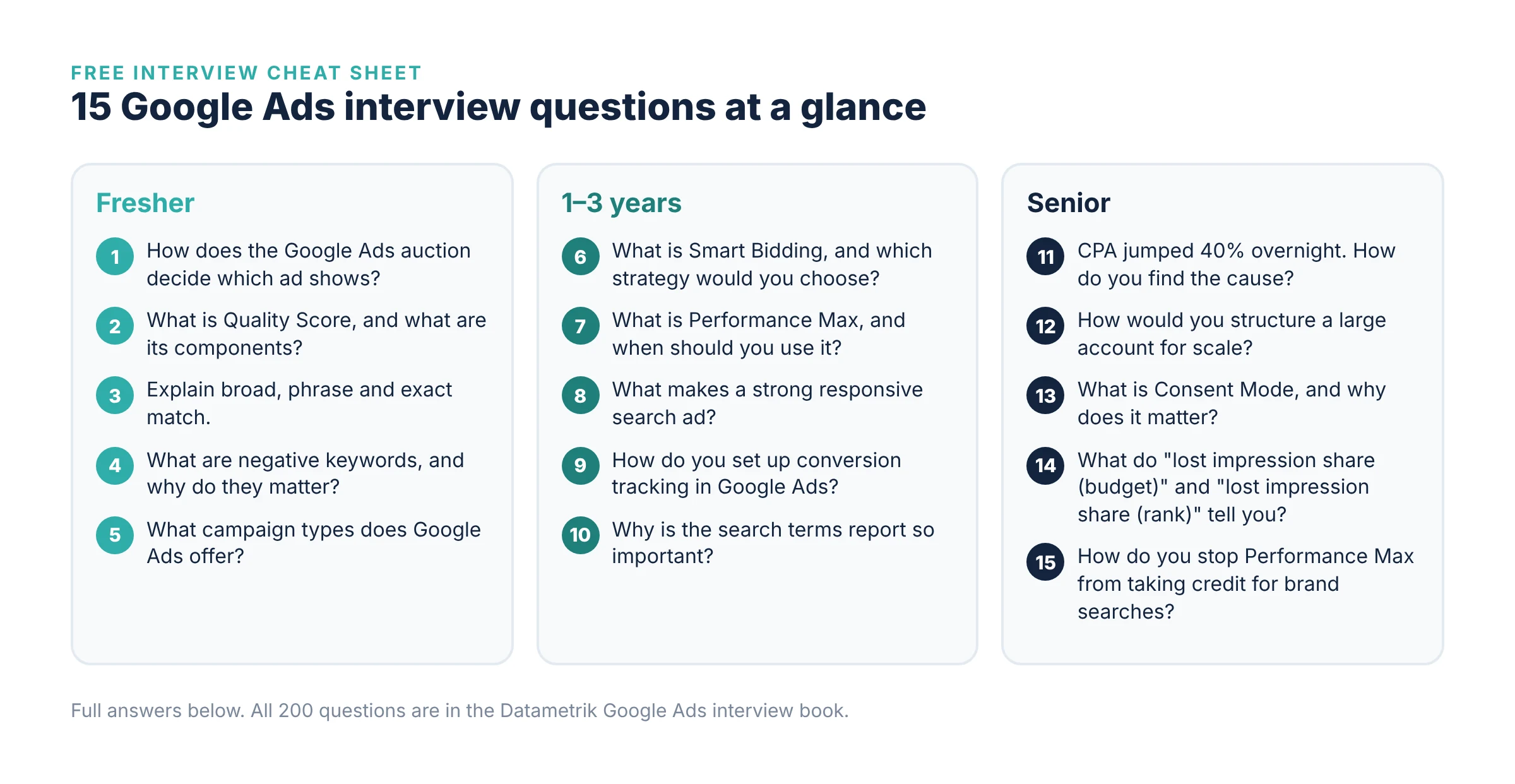
All 15 questions at a glance. Full answers are below.
Fresher Google Ads interview questions
Q1. How does the Google Ads auction decide which ad shows?
Fresher
Google runs an auction every time someone searches.
It ranks ads by Ad Rank, not just by bid.
Ad Rank uses your bid, ad quality and expected impact of assets.
It also considers context, like device and location.
So a better ad can beat a higher bid.
Testing: Do you know quality matters as much as money?
Q2. What is Quality Score, and what are its components?
Fresher
Quality Score is a 1 to 10 rating at keyword level.
It has three parts.
Expected click-through rate.
Ad relevance to the keyword.
Landing page experience.
It is a diagnostic tool, not a direct input to the auction.
Testing: Can you name all three parts and use them to improve ads?
Q3. Explain broad, phrase and exact match.
Fresher
Exact match shows ads for searches with the same meaning as your keyword.
Phrase match shows ads for searches that include your keyword’s meaning.
Broad match shows ads for related searches too.
Broad match works best with Smart Bidding and good conversion data.
Always review the search terms report, whatever the match type.
Testing: Do you know modern match types are about meaning, not exact words?
Q4. What are negative keywords, and why do they matter?
Fresher
Negative keywords stop ads from showing for unwanted searches.
For example, adding “free” if you only sell paid products.
They cut wasted spend and improve conversion rates.
You can add them at campaign level or in shared lists.
Find them in the search terms report.
Testing: Do you actively control spend, or just add keywords?
Q5. What campaign types does Google Ads offer?
Fresher
Search, for text ads on Google results.
Performance Max, which runs across all Google channels from one campaign.
Demand Gen, for visual ads on YouTube, Discover and Gmail.
Display, Video, Shopping and App campaigns.
Pick the type based on the goal and the customer journey.
Testing: Can you match campaign type to business goal?
Our Google Ads Interview Questions & Answers (200 Qs) has all 200 questions with full answers.
Each answer comes with an easy version to say out loud.
Not ready to buy? Try the free Google Ads mock test first.
1–3 years Google Ads interview questions
Q6. What is Smart Bidding, and which strategy would you choose?
1–3 years
Smart Bidding uses Google’s AI to set bids for each auction.
Maximise conversions spends the budget to get the most conversions.
Target CPA aims for a set cost per conversion.
Target ROAS aims for a set return on ad spend.
Maximise conversion value grows revenue within the budget.
Choose based on the goal and how much conversion data you have.
Testing: Can you justify a strategy, not just name one?
Q7. What is Performance Max, and when should you use it?
1–3 years
Performance Max is a goal-based campaign type.
One campaign can serve on Search, YouTube, Display, Gmail, Discover and Maps.
You give it assets, audience signals and a conversion goal.
Google’s AI decides where to show ads.
It works best with clean conversion tracking and enough budget.
Use brand exclusions if it eats into branded search.
Testing: Do you know PMax’s strengths and its blind spots?
Q8. What makes a strong responsive search ad?
1–3 years
You can add up to 15 headlines and 4 descriptions.
Use different angles: benefits, features, offers and proof.
Include keywords in a few headlines, not all.
Pin only when you must, because pinning reduces testing.
Watch ad strength, but judge by real conversion results.
Testing: Do you write ads for testing, not just for approval?
Q9. How do you set up conversion tracking in Google Ads?
1–3 years
Use the Google tag, often through Google Tag Manager.
Or import conversions from a linked GA4 property.
Turn on enhanced conversions to improve match rates.
Set the right counting option, like “one” for leads.
Test with Tag Assistant before going live.
Need help? See our GTM setup service.
Testing: Do you know bad tracking breaks every bidding strategy?
Q10. Why is the search terms report so important?
1–3 years
It shows the real searches that triggered your ads.
Keywords show what you bid on.
Search terms show what you actually paid for.
Use it to add new keywords and new negatives.
Check it weekly, especially with broad match or PMax.
Testing: Do you manage the account from real user behaviour?
Our Google Ads Interview Questions & Answers (200 Qs) has all 200 questions with full answers.
Each answer comes with an easy version to say out loud.
Not ready to buy? Try the free Google Ads mock test first.
Senior Google Ads interview questions
Q11. CPA jumped 40% overnight. How do you find the cause?
Senior
Check tracking first.
Did conversions drop, or did costs rise?
Then check change history for bids, budgets or new campaigns.
Look at auction insights for new competitors.
Segment by device, location, network and search term.
Fix the cause, not the symptom.
Testing: Do you diagnose with data, in a calm order?
Q12. How would you structure a large account for scale?
Senior
Keep structure simple so algorithms get enough data.
Separate brand and non-brand search.
Group campaigns by goal and margin, not by every keyword.
Use shared budgets and portfolio bidding where it helps.
Too many small campaigns starve Smart Bidding of data.
Testing: Do you understand consolidation in an AI-led platform?
Q13. What is Consent Mode, and why does it matter?
Senior
Consent Mode tells Google tags what each user agreed to.
Tags then adjust how they collect data.
Without consent signals, conversions can go missing.
Google uses modelling to fill some of those gaps.
It is required for advertisers targeting users in the EEA.
Testing: Do you keep up with privacy changes that affect measurement?
Q14. What do “lost impression share (budget)” and “lost impression share (rank)” tell you?
Senior
Lost IS (budget) means your budget ran out.
More budget could win more auctions.
Lost IS (rank) means your Ad Rank was too low.
Improve quality, landing pages or bids to win those auctions.
Each one needs a different fix.
Testing: Can you turn a metric into the right action?
Q15. How do you stop Performance Max from taking credit for brand searches?
Senior
Add brand exclusions to the PMax campaign.
Run a separate brand search campaign with its own budget.
Check search term insights inside PMax.
Compare new customer rates, not just ROAS.
Test with and without PMax to measure real lift.
Testing: Can you see past platform-reported ROAS?
How to prepare for a Google Ads interview
Reading answers is not enough.
You need to say them out loud, under a little pressure.
- Say each answer out loud in under 60 seconds.
- Add one real example from your own work to every answer.
- Take the free Google Ads mock test to find weak topics.
- Practise troubleshooting questions most, because they decide offers.
- Revise the basics the night before, not new topics.
Get all 200 Google Ads interview questions
These 15 questions are a free sample.
The full book has 200 questions, from fresher to senior.
Every answer has an interview version and a simple version.
It costs ₹1,299, delivered instantly as a PDF.
Sources:
- Google Ads Help: About Quality Score
- Google Ads Help: About Performance Max campaigns
- Google Ads Help: About Smart Bidding
Related reading:
- Track GA4 high-value audiences in Google Ads
- Merchant Center misrepresentation suspension fix
- DV360 interview questions and answers
- All Datametrik interview books
Need hands-on help with Google Ads?
Contact our team.
Run Google Ads day to day? When an account dips, our Google Ads script explains why in plain English: find out why your Google Ads performance dropped →
Written By
Chetna leads content creation at Datametrik, turning complex programmatic workflows, ad operations, paid media strategies, and SEO frameworks into practical, step-by-step guides.
Technically Reviewed & Verified By
Every Datametrik guide is audited for live platform accuracy, bidding mechanics, and tracking setup by our technical editors with programmatic media buying and Ad Ops experience across WPP, Cognizant, and Dentsu.

Comments are closed.